

FM, in the revised estimates for 2012-13, projected a fiscal deficit of 5.2 per cent. This is now likely to be revised in light of better than expected revenue realisation and savings.

The GST will be a national sales tax that will be levied on consumption of goods or use of services
The government's tax collections grew by over 14 per cent to Rs 1,63,611 crore (Rs billion) (Rs 1,636,11 billion) till December mainly due to impressive growth in corporate tax.
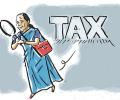
From road transport to health insurance, tax rules have changed from October 1.

The principal commissioner has been made responsible for developing and approving any intelligence, conducting search, and completing investigations and relevant subsequent actions, including at the lower field formations, points out T N C Rajagopalan.

By November 3, only 17,000 applications with tax payable amounting to Rs 1,100 crore have been received by the government, under the Sabka Vishwas Legacy Dispute Resolution Scheme. The scheme gives a deep discount of 70 per cent for cases pending appeal where tax demand is more than Rs 50 lakh, and 50 per cent waiver beyond that amount.
But the party favoured most of the proposals on indirect taxes.

For every rupee in the government coffer, 58 paise will come from direct and indirect taxes, 34 paise from borrowings and other liabilities, six paise from non-tax revenue like disinvestment and two paise from non-debt capital receipts, according to the Budget documents for 2023-24.
The direct tax collections posted a 20.42 per cent growth totalling Rs 36,733 crore upto October 15, but indirect tax collections were less buoyant, recording about eight per cent growth at Rs 63,413 crore upto September 30, this financial year.

The collection from borrowings and other liabilities will be 20 paise, while income tax will yield 17 paise to every rupee collection.

Jaitley said future transactions would be substantially digital as India moves towards a less-cash society

By doing away with the 1 per cent inter-state tax over and above the GST rate, the government has met one of the three key demands over which Opposition Congress has been blocking the Bill in the Upper House
The Prime Minister's Economic Advisory Council on Wednesday favoured more income tax sops as also a revision in indirect tax rates on consumer durables in Budget 2008-09 to fire up the economy.

'I believe the modified scheme is much more beneficial and simpler.'
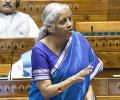
'When people have money in their hands, they make their judgment about whether they want to spend it entirely or spend some out of it.'

'As negotiations continue, the path forward demands not only diplomatic skill, but also vigilance against legal asymmetries embedded in America's trade playbook.'

The company's net loss widened to Rs 444.26 crore (Rs 4.44 billion) for the quarter ended December 31, 2011, due to high fuel costs and weaker rupee from Rs 253.69 crore (Rs 2.53 billion) in the October-December quarter in the last fiscal.
The other two components of indirect tax collections -- excise and customs duties -- were already in negative territory since October 2008. In particular, excise -- a levy on factory production levied at the gates - has started declining from September.

The government on Friday said GST will not be applicable on residential units if they are rented out to private persons for personal use. The government dismissed media reports which claimed that there is an 18 per cent Goods and Services Tax (GST) on house rent paid by tenants. In a tweet, the government said GST would be levied only when the residential unit is rented out to a business entity.
The government on Monday said the total tax revenue in 2011-12 would be up 18.50 per cent at Rs 9,32,439.88 crore, on the back of projected rise in revenue from taxes on income, services, customs and excise duties.

Corporation tax is the single largest source of income, contributing 21 paise to each rupee earned.

The government on Tuesday said that tax arrears rose over 18 per cent to Rs 2.93 lakh crore as on March 31, 2010 against the year-ago period.

India's economic growth slowed to a 15-month low of 6.7 per cent in April-June 2024-25, mainly due to poor performance of the agriculture and services sectors, government data showed on Friday. The gross domestic product (GDP) expanded by 8.2 per cent in the April-June quarter of 2022-23. India, however, remained the fastest-growing major economy, as China posted a 4.7 per cent growth in April-June 2024.
Tax collections grew by 18 per cent at Rs 2,52,162 crore (Rs 2,521.62 billion), crossing the Budget target and pushing up the tax-GDP ratio to 9.1 per cent, during 2003-04.

The new Foreign Trade Policy announced a slew of tax concessions to boost exports, which have been on the downslide since October 2008.
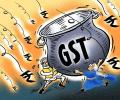
GST collection grew by 12 per cent in April to Rs 1.87 lakh crore, the highest monthly mop-up since the rollout of the indirect tax regime. The gross GST revenue collected in the month of April 2023 is Rs 1,87,035 crore of which CGST is Rs 38,440 crore, SGST is Rs 47,412 crore, IGST is Rs 89,158 crore (including Rs 34,972 crore collected on import of goods) and cess is Rs 12,025 crore, the finance ministry said in a statement. The previous high collection of Rs 1.68 lakh crore was in April last year.
Budget to be presented on Friday is expected to carry out a "clean up" operation of tax administration besides measures to spur growth.

Chidambaram to meet revenue boards on how to get much more and quickly; special audits and notices among measures likely.

All eyes will be on whether Sitharaman will deliver a populist budget leaving more money in hands of the common man or push the reform agenda by staying on the fiscal glide path to lower the fiscal deficit to 4.5 per cent of GDP by 2025-26.

'If you compare the data from 2017 and 2023 of the US imports from the world and China, you will see that the US was a complete loser in the trade war, and China was a complete gainer.'

Overall market reaction to the Budget was neutral. Investors absorbed the changes to the tax rates (positive for salaried class) and capital gains taxes (CGTs, negative due to the removal of indexation and increases. Other proposals largely pertain to supporting rural development, buybacks taxed as dividends, Custom duty changes that impact multiple sectors, higher outlays for clean energy, etc. There's some moderation in the growth of capex outlay across defence, fer

Average monthly GST collection rose from Rs 90,000 crore during the first year of its implementation -- 2017-2018 -- to Rs 1.68 trillion during 2023-2024, representing an 87 per cent rise.

The e-commerce sector is also fraught with redundant taxation laws that need immediate overhaul
 © 2026 Rediff.com - Advertise with us - Disclaimer - Privacy Policy - Sitemap - Feedback - About us - Terms of use - Grievances